REG Reviews

REG Reviews – January 2026

6th January 2026

Welcome to your January Edition of REG Reviews!

Last month, the FCA mandated reporting of complaints involving vulnerable customers, cyber insurance prices dropped despite tougher underwriting, FCA figures revealed a sharp drop in insurance AR numbers, and UK insurers maintained an ESG focus with tangible impact…

Read these articles and many more as we bring you all the important news and views in the insurance and financial services world…


Industry News​

REGULATORY

New FCA Rules on Vulnerable Customer Complaints

The Financial Conduct Authority (FCA) has implemented a new requirement obliging firms to report complaints that involve customers in vulnerable situations.

This update was highlighted as a central element of a new reporting process announced on last month, on December 3rd, which is designed to simplify how firms submit complaints data to the regulator.

The change will allow the FCA to better track outcomes for vulnerable customers and assess whether firms are offering suitable support. It follows the release of new advice from the Chartered Insurance Institute aimed at helping firms improve their approach to supporting customers in vulnerable situations.

Under the new framework, five separate complaints returns will be combined into one unified report, with the goal of improving data accuracy and strengthening consumer protection across the market. The watchdog says this will streamline reporting, reduce duplication, and create more consistent and comparable datasets, as reported by Insurance Post.

The changes will also include enhanced guidance alongside standardised six-monthly reporting for all firms, aimed at improving data timeliness, enabling better comparisons, and ensuring complaints data is practical, reliable, and valuable for the market and consumers.

According to Sarah Pritchard, deputy chief executive of the FCA: “These improvements are a significant step forward in ensuring transparency and consistency across the sector. By streamlining returns and introducing clearer guidance, we’re making it easier for firms to provide high-quality complaints data while strengthening our ability to protect consumers, particularly those who are most vulnerable.”

Richard Pinch, senior director of risk at UK consultancy Broadstone reported that: “The additional granularity in data that the regime will create is to be welcomed, as it will ensure accountability at firm level, more efficient regulatory scrutiny and a greater ability to intervene on behalf of consumers.”

TECHNOLOGY

Soft Market, Hard Choices

In 2025, the cyber insurance market finds itself at a pivotal point. Despite a surge in high-profile cyber-attacks worldwide, the market remains paradoxical: premiums are softening, yet coverage has become increasingly complex and restrictive. Organisations seeking protection must navigate a shifting landscape of risks, tightening regulatory demands, and more exacting underwriting standards.

Recent cyber incidents have highlighted the financial stakes of inadequate protection. While some firms have weathered breaches successfully with robust insurance cover, others without adequate policies have faced significant financial losses. These contrasting outcomes underscore the critical role of cyber insurance in helping organisations absorb the financial impact of a breach, manage reputational risk, and access specialist support services.

Interestingly, the growth in cyber risks has not led to uniformly rising premiums. Across the UK and Europe, premiums have eased in recent years, even as the number and severity of cyber-attacks have increased. This marks a reversal from the steep rises seen in previous years, reflecting a more competitive market and a desire among insurers to maintain market share in an increasingly crowded space.

However, a softer market does not equate to easier access. Insurers are imposing stricter underwriting requirements, demanding clear evidence of strong cybersecurity practices, and often applying broader exclusions and higher deductibles. A growing number of claims are being declined where organisations cannot demonstrate sufficient risk mitigation or provide comprehensive breach documentation.

Regulatory pressures are also reshaping the landscape. New laws in the UK and across Europe, alongside evolving data breach and cybersecurity regulations in the US, are raising compliance expectations for businesses. Organisations are increasingly required to demonstrate robust security measures not only to avoid penalties but also to qualify for coverage and manage liability.

The rise of AI-driven threats is adding further complexity. Cybercriminals are employing advanced technologies for reconnaissance and exploitation, forcing insurers to reconsider risk assessments and, in some cases, exclude AI-related exposures from coverage.

Despite these challenges, cyber insurance remains a key element of organisational risk management. Many companies are choosing policies with higher deductibles while valuing the additional services included, such as incident response, legal guidance, and forensic investigation support. The focus is shifting from simply transferring financial risk to leveraging insurance as a broader risk mitigation tool.

Ultimately, while falling premiums may appear attractive, the reality for businesses is more nuanced. In a market where cyber threats continue to evolve and underwriting becomes more demanding, securing the right policy is about matching coverage to risk and ensuring organisational resilience, rather than seeking the lowest possible price.

FINANCE

Lloyd’s Signals Growing Softening Market Risks​

Rachel Turk, chief of market performance at Lloyd’s has warned during a management team’s quarterly market message that rates are softening faster than expected in the market.

She addressed managing agents directly, saying that: “The rating environment has softened quicker than anticipated, but we see you pick your way through this and focus on the bottom line.”

She added: “There are, of course, pockets of concern, but in aggregate, trading conditions have been favourable. But we need to be realistic about the challenges ahead, look around corners and try to manage the inevitable slide towards the softest part of the cycle.”

Lloyd’s syndicates plan to achieve £67.4bn in gross written premiums in 2026, up 13% from the Q3 2025 forecast but only 2.3% organic growth largely fueled by new market entrants and innovative solutions, while casualty business stands out with modestly increasing rates, Turk said.

Furthermore, Turk said cyber insurance faces a supply-demand imbalance, with growth stalling and the market competing for the same customers.

She explained that: “Cyber has a dynamic and evolving risk landscape, and while we continue to update the models and scenarios, I fear that views on adequacy will always be optimistic and out of date.”

Turk also warned that rapidly falling property rates are a major concern, drawing parallels with past pricing downturns that led to poor underwriting outcomes. She stressed that margin-eroding rate declines and unrealistic growth targets in weak market conditions will not be tolerated.

Finally, Turk warned against aggressively pursuing growth via structured solutions like broker facilities, stressing that the shift demands strong oversight. While recognising their strategic importance and operational efficiencies, she said tighter control is essential as the market develops.

She concluded: “We all anticipate that trading conditions will be tougher in 2027 than in 2026, but my final plea is not to pull forward these tougher conditions any earlier than strictly necessary by chasing top line, chasing down rate and eroding margin.”

REG UPDATES

REG Technologies Receives Majority Investment from Accel-KKR to Accelerate Product Innovation and International Growth

London, UK
December, 4 2025 


REG Technologies, a recognised innovative provider of compliance and regulatory software for the insurance and financial services sector, today announced that it has received a strategic majority investment from Accel-KKR, a leading global private equity firm focused on technology and enterprise software. The partnership will enable REG Technologies to accelerate innovation, strengthen its commercial capabilities and expand into new markets.

Insurance and financial services organisations are facing rising regulatory complexity and operational risk when engaging with counterparties. Founded in 2013, REG Technologies enables firms to identify and verify counterparties, streamline onboarding and due-diligence workflows, and maintain ongoing compliance monitoring throughout the lifecycle of a business relationship. The platform supports brokers, Managing General Agents (MGAs), carriers, insurance and financial services networks in mitigating risk exposure and improving operational efficiency in increasingly regulated environments.

Accel-KKR’s investment will support REG Technologies as it seeks to advance its product roadmap, enhance customer value and pursue international expansion opportunities. As part of the Accel-KKR portfolio, REG Technologies will leverage the firm’s global resources and software domain expertise.

“REG Technologies plays a meaningful role in helping insurance and financial services organisations manage regulatory complexity with confidence,” said Phil Cunningham, Managing Director at Accel-KKR. “We are pleased to partner with the team as they continue to develop the platform and broaden its reach across the industry.”

Osborne Clarke served as legal advisor to REG Technologies and its shareholders, and NovitasFTCL served as M&A advisor to the company. Brodies served as legal advisor to Accel-KKR. 

About REG Technologies:

REG Technologies is a compliance and regulatory risk software provider serving the insurance and financial services industry. The company’s platform enables organisations to identify and verify counterparties, streamline onboarding and due-diligence workflows, and maintain ongoing compliance monitoring throughout the business relationship. REG Technologies supports brokers, Managing General Agents, carriers, insurance and financial services networks in meeting regulatory requirements and reducing operational and counterparty risk. Founded in 2013, the company is headquartered in London.

About Accel-KKR:

Accel-KKR is a technology-focused investment firm with over $23 billion in cumulative capital commitments. The firm focuses on software and tech-enabled businesses, well-positioned for topline and bottom-line growth. At the core of Accel-KKR’s investment strategy is a commitment to developing strong partnerships with the management teams of its portfolio companies and a focus on building value alongside management by leveraging the significant resources available through the Accel-KKR network.

Accel-KKR focuses on middle-market companies and provides a broad range of capital solutions, including buyout capital, minority-growth investments, and credit alternatives. Accel-KKR also invests across various transaction types, including private company recapitalizations, divisional carve-outs, and going-private transactions. Accel-KKR’s headquarters is in Menlo Park, with offices in London, Atlanta and Chicago.

ESG

UK Net Migration Falls Sharply to 204,000

Net migration to the UK has undergone a dramatic correction, declining by two-thirds in the year leading up to June, reaching 204,000. This is the lowest level recorded since the pandemic. This sharp adjustment, driven by a significant reduction in arrivals and a rise in departures, stands in contrast to the peak of 906,000 seen in the year to June 2023. The figure also represents a substantial drop from the 649,000 reported in the year to June 2024, marking a shift few analysts had anticipated.  

The data, published by the Office for National Statistics (ONS), highlights important demographic changes for both employers and policymakers. Notably, there was a net outflow of both EU and UK citizens, with younger adults comprising the majority of those leaving. Approximately 76% of departing UK citizens were under the age of 35, underscoring concerns about the long-term composition of the labour market.  

The picture differs for non-EU nationals. While there remained a positive net inflow, the balance has narrowed considerably. Around 383,000 more non-EU nationals arrived than left during the latest period, less than half the 825,000 recorded in the previous year. In contrast, about 70,000 more EU nationals left the UK than arrived, and 109,000 more UK citizens departed than returned, signalling overall outward movement.  

These shifts come alongside growing pressure on the asylum system. Separate Home Office figures show asylum claims have reached a new record of 110,051 in the year to September, slightly higher than the 109,142 reported to June. As noted by Madeleine Sumption, Director of the Migration Observatory at the University of Oxford, overall net migration may have reverted to pre-Brexit levels, but “the composition is now different”, with non-EU migration remaining significantly higher and asylum pathways forming a larger share of entries.  

Long-term immigration also fell sharply, dropping 31% to 898,000, while long-term emigration increased 6.7% to 693,000. In response, the government has set out proposals to overhaul legal migration routes and reform asylum processes. Plans include accelerated settlement for certain high earners and entrepreneurs, while others may face far longer qualification periods. Asylum protections will also be tightened, with temporary status and reduced entitlements for many applicants.  

While ministers have welcomed the reduction in net migration, the Home Secretary acknowledged that “the pace and scale of migration has placed immense pressure on local communities”, signalling further policy interventions ahead.  

REGULATORY

Government Confirms Jury Trial Cuts for Lower Level Offences 

The government has confirmed a significant shift in the criminal justice system, announcing that jury trials in England and Wales will be removed for offences likely to attract prison sentences of less than three years. The change form part of a wider plan to tackle what ministers describe as “unprecedented delays” across the courts, with the Crown Court backlog now approaching 78,000 cases and projected to reach 100,000 by 2028.  

Under the changes, new “swift courts” will handle lower-level cases without juries, while serious crimes such as murder, rape, aggravated burglary and major drug offences will continue to go before a Crown Court jury. Justice secretary David Lammy described the changes as “bold” but “necessary”, arguing that cases could be resolved “a fifth faster” under the new model. With some trials already being listed as far ahead as 2030, Lammy said the right to a “swift and prompt trial” was now a core issue of fairness.  

The change is also a significant retreat from earlier proposals, outlined in a leaked draft which would have removed juries from cases carrying sentences of up to five years. The final package aligns more closely with recommendations from retired senior judge Sir Brian Leveson, whose government-commissioned review argued in July that “fundamental” reforms were needed to prevent “the risk of total system collapse”. Leveson also proposed jury-free trials for complex fraud cases and expanded options for out-of-court disposal.  

Critics argue that the measures strike at the heart of long-standing legal protections. The Criminal Bar Association said the changes “bring a wrecking ball to a system that is fundamentally sound”, insisting that “juries work… superbly, and without bias.” Legal experts also warn that removing juries may undermine trust among communities that already perceive disparities in the justice system. As one solicitor advocate cautioned, judge-only trials “risk deepening existing inequalities and eroding confidence among communities who already feel marginalised.”  

Concerns also remain about whether the change will meaningfully reduce delays. While magistrates already handle around 90% of criminal cases, expanding their remit, including new sentencing powers of up to 18 months, will require additional resources. Barristers note that the root causes of the backlog lie in years of underfunding, staffing shortages and a deteriorating court estate.  

With legislation required before changes take effect, the sector now awaits the second part of Leveson’s review, expected later this year, which will outline further proposals on technology, case management and court efficiency. 

CYBER

How the UK Cyber Bill Could Boost Cyber Insurance

The UK is facing a growing cyber threat environment. Attacks are becoming more frequent, more sophisticated and more costly for businesses of all sizes. Against this backdrop, cyber insurance has a vital role to play in strengthening resilience and transferring financial risk. Yet the UK’s cyber insurance market remains underdeveloped compared with other advanced economies, leaving many organisations exposed and under-protected.

One of the root causes of this lagging market is the absence of clear, consistent regulatory incentives that drive businesses to adopt comprehensive cyber insurance. Current UK law relies on outdated frameworks with limited scope and weak enforcement, producing a fragmented data landscape, inconsistent security standards and high premium costs. These structural gaps have kept cyber insurance penetration low, especially among small and medium-sized enterprises, and discouraged the development of a vibrant insurance market that could allocate risk more effectively.

The UK government’s proposed Cyber Security and Resilience Bill seeks to modernise the regulatory framework for cybersecurity. It introduces stricter statutory baselines for security practices, enhances incident reporting requirements and expands regulatory scope to include additional digital infrastructure providers. This represents a significant step forward from previous legislation and can help level up the UK’s approach to cyber risk management.

By codifying a uniform risk assessment baseline, firms of all sizes will have clearer guidance on how to strengthen their defences. This should reduce weak links in key sectors, promote more consistent cyber hygiene practices and generate richer, more standardised incident data. Better quality data is critical for insurers because it improves actuarial modelling, reduces uncertainty in underwriting and ultimately supports fairer, more transparent pricing of premiums.

However, the current draft of the Bill stops short of fully integrating mechanisms that would spur widespread adoption of cyber insurance. It does not yet provide infrastructure for centralised, confidential sharing of cyber incident data, nor does it address ambiguous insurance policy language that often leads to coverage disputes and market uncertainty. Furthermore, enforcement remains linked to firm size rather than risk profile, creating loopholes that may allow critical smaller entities to remain unregulated and uninsured.

To address these shortcomings and unlock the cyber insurance market’s full potential, a range of enhancements could be adopted. Establishing a national cyber incident information exchange would supply insurers with meaningful, anonymised datasets that improve risk models and reduce pricing volatility. Developing standardised policy wording and an underwriting glossary would simplify coverage interpretation and boost market confidence. A state-backed cyber reinsurance pool could cover extreme, catastrophic losses that are currently excluded from many policies, instilling greater capacity within the private market. Finally, a regulatory sandbox tailored to cyber insurance innovation could encourage experimentation with new products and data‑driven pricing approaches.

These measures would strengthen the connection between regulatory compliance and insurance uptake, supporting broader coverage, improved resilience and a more competitive cyber insurance sector. For the UK economy, promoting a thriving cyber insurance market is not just about financial protection it is about encouraging better security practices and building national resilience in an increasingly digital world.

REG UPDATES

Your REG Wrapped 2025 is Here!

2025 was a year of growth, change, and increasing complexity across the market and with that came an even greater need for firms to stay informed and proactive when it comes to counterparty risk.

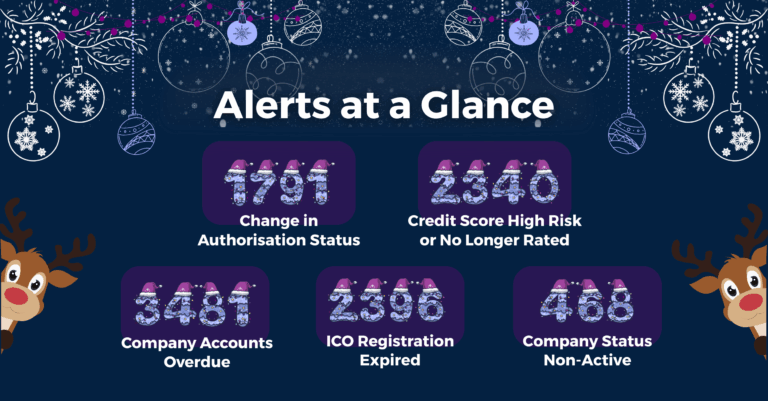
Throughout the year, REG Technologies supported customers by keeping them up to speed with the changes that matter most. From regulatory updates to company status shifts and credit risk indicators, our alerts helped firms spot potential issues earlier and strengthen oversight across the distribution chain.

Our REG Wrapped 2025 brings this to life, highlighting the alert trends from the year and giving a clear picture of the types of risks we’re here to help you manage.

Whether it’s a change in authorisation status, a company becoming inactive, overdue accounts, expired ICO registrations or shifts in credit risk, these alerts reflect the reality of today’s environment, where things can change quickly, and visibility is key.

Each alert is designed to do more than just inform. It’s about giving you the confidence to act sooner, stay ahead of potential issues, and make better decisions across your counterparty network.

At the heart of everything we do is a simple goal: helping firms move away from manual, reactive monitoring and towards smarter, more connected counterparty risk management.

By bringing key insights into one place, REG helps reduce the burden of ongoing checks, strengthens oversight, and makes it easier to stay on top of risk, without adding complexity.

As we head into the new year, our focus continues to support firms to stay informed, reduce manual effort, and strengthen counterparty oversight as the market continues to evolve.

To our customers, thank you for being part of our story. 2025 brought growth, great collaboration, and standout milestones, and we couldn’t have done it without you. You trusted us this year, and we’re excited to keep building on that in 2026.

And if you’re not yet working with REG, but want to understand how we help firms stay ahead of change and manage counterparty risk more effectively, we’d love to continue the conversation.

Here’s to building on what we’ve achieved and making 2026 an even stronger year together!

ESG

How ESG Expectations Are Evolving Under Pressure

Although ESG priorities were once front and centre for UK insurers, recent uncertainty and investor scrutiny have prompted debate over whether commitment has softened. However, at an Insurance Post roundtable backed by Crif, sustainability leaders highlighted ongoing efforts to deliver tangible outcomes and support SMEs in adopting meaningful, defensible ESG practices.

Insurers now say ESG has moved from aspiration to execution, with clear gains across operations, investments and products. Firms such as Allianz and AXA UK highlighted progress through workforce sustainability training, growth in low-carbon solutions and investment strategies that continue to outperform financial expectations.

According to Chris Pitt, group impact director at Benefact Group, ESG is now embedded in the company’s culture and stakeholders minds, emphasising that: “ESG is a core part of the conversation now. Colleagues, regulators and customers all expect it.”

Ben Bull, ESG lead at PIB Group added at the roundtable that now customers and staff understand much better the meaning of ESG compared to some years ago, with firms’ recognising the positive outcomes that ESG investment yields.

Across Europe and the UK, clients and investors’ expectations, coupled with other varying regulatory pressures, are shaping insurance firms’ ESG efforts.

As reported by Hannah Speakman, sustainable underwriting lead at Allianz UK, larger commercial clients expect more and tend to ask more specific detailed questions compared to smaller counterparts who aren’t sure about the next steps despite knowing the importance of ESG.

Moreover, AXA and Allianz added that staff’s engagement and values play a huge part in shaping a firm’s ESG strategy as well.

As Bull said: “SMEs know ESG matters but can’t identify which areas are most material to them. Helping them narrow that focus is essential.”

Insurers are also actively supporting brokers with tools and training to help SMEs act on ESG, with initiatives focused on emissions measurement, transition planning, and practical climate advice, as reported by Speakman.

Insurers are increasingly using ESG data to link sustainability and resilience measures to pricing and product design, turning sustainable actions into tangible commercial benefits.

Bull stressed that brokers and insurers must work hand in hand to ensure ESG success, emphasising the importance of clear guidance on the information underwriters need to help customers evidence it.

Despite economic and political pressures reshaping the conversation, insurers’ commitment to ESG remains strong, with a greater focus on risk, resilience, and business value. The roundtable’s participants noted that credible progress now depends on evidence-based action rather than rhetoric, as firms avoid keeping sustainability work quiet and adapt to more demanding frameworks.

The main takeaway from this Insurance Post roundtable is that ESG isn’t going anywhere, regardless of terminology tweaks. The most important thing moving forward is using reliable data and fostering strong collaborations between different insurance intermediaries to achieve positive ESG outcomes.

REGULATORY

Stricter Oversight Causes AR Decline

FCA data shows a sharp decline in the number of appointed representatives in the insurance sector, falling from around 14,000 in 2019 to just over 7,000 in 2025, a drop likely linked to tighter regulatory oversight and burden.

FCA figures show that the decline in appointed representatives is specific to the insurance sector, while numbers have remained steady in consumer investments and risen sharply in consumer finance. Despite this, ARs generated the highest regulated revenue for insurance in 2024, contributing £3.5 billion.

Julie Comer from BIBA speculated that the drop in AR numbers could stem from firms moving to direct authorisation, while acknowledging this is not confirmed.

Julie also emphasised on the importance and of ARs, but recognised the “increased responsibility” that comes with monitoring them and the heavy weight it puts on brokers.

These speculations certainly raise the question whether firms must consider investing in newer robust systems and technology that lifts the regulatory burden and therefore allows principals to monitor their ARs better and eliminate chances of regulatory breaches.

While firms might associate investing in regulatory technology as expensive, the costs of non-compliance or not taking ARs on board could far outweigh the benefits, which include:

  • Automated real-time monitoring and dashboards
  • Freed up time for compliance teams and management to focus on strategic tasks.
  • Reduced financial and cyber risks.

Over the past two years, the FCA has strengthened rules for appointed representatives, requiring principals to implement stricter oversight, regular reviews, and detailed reporting. Non-compliance carries enforcement risk, with seven firms sanctioned in 2023 and 2024 for failing to ensure their ARs follow the rules.

According to Hugh Savill, senior adviser at Sicsaic Advisory, who believes tougher regulation has resulted in businesses to recruit ARs in house: “Looking back over the past 18 months, the FCA has gradually been cracking down on appointed representatives — or more to the point, cracking down on principals: how they monitor their ARs, how they appoint them, and the standards they’re expected to maintain.”

Despite the decline in AR numbers, many insurers remain committed to using appointed representatives as a key distribution channel, as reported by Insurance Post.

To this day, many firms are still reluctant to invest heavily in RegTech, relying instead on time-consuming, error-prone legacy processes that increase the risk of breaches.

However, insurers must think outside the box and adopt the right technology to continue effectively supporting their use of ARs.

CYBER

UK Cyber Insurance Demand Rises in 2025 Amid High Profile Attacks and Softening Rates

The UK cyber insurance market has seen a noticeable uptick in demand throughout 2025, driven by a series of large‑scale cyber incidents and ongoing competitive pricing. After several years of relatively low take‑up, more businesses are now submitting cyber insurance applications as the reality of digital threats becomes impossible to ignore.

A spate of high profile cyberattacks affecting major firms across the UK and Europe has compelled organisations to rethink their approach to risk management. As attacks grow in frequency and sophistication, boardrooms are increasingly aware that cyber incidents pose not just an IT headache but a serious financial and operational threat to business continuity. In turn, this awareness has translated into stronger interest in policies that can help absorb financial losses, support incident response and provide access to expert services when breaches occur.

Interestingly, this rise in demand has taken place even as insurers continue to soften their pricing. After a period of rate hardening driven by severe claims and market correction, 2025 has seen modest reductions in cyber insurance premiums. Competitive pressures, combined with some insurers’ strategic efforts to broaden their client base, have kept pricing relatively attractive. This dynamic has encouraged some risk managers to revisit coverage they might previously have dismissed as too costly.

However, the interplay between softening rates and tighter underwriting standards has created a nuanced market environment. Insurers still set stringent conditions for cover, requiring firms to demonstrate strong cyber controls and robust risk management practices before policies are issued. This means that while pricing may be more accessible, organisations without meaningful cybersecurity measures in place may struggle to secure the level of coverage they seek.

The increase in demand underscores a growing recognition that cyber insurance is not optional. Many firms now view it as a core component of resilience planning rather than a luxury add‑on. Policies are valued not only for financial indemnity but also for ancillary benefits such as incident response support, access to forensic expertise and guidance on regulatory compliance. For many mid‑sized organisations especially, these support services can be as important as the monetary value of the policy itself.

Despite positive momentum, gaps remain. Take up rates among smaller businesses are still significantly lower than among large enterprises, which often have dedicated risk and security teams. Barriers such as perceived cost, limited awareness of cyber insurance’s benefits and uncertainty about coverage terms continue to deter some firms from purchasing policies.

Looking forward, the UK market is poised for further growth. Continued cyber‑attack activity is likely to keep pressure on organisations to obtain protection, while competitive dynamics among insurers may sustain more favourable pricing than seen in earlier years. As awareness rises and underwriting processes evolve, cyber insurance could become a much more widespread feature of the UK business landscape helping companies manage risk more effectively in an era where digital threats are an everyday reality.

This article was published by:

Article author:

REG Technologies Logo
REG Technologies

REG Technologies powers the insurance world to accelerate compliant trade. Helping insurance businesses trade faster, smarter, safer.

020 3946 2880

info@reg.uk.com

See how The REG Network can help you

Talk to one of our experts to start streamlining your processes