










Blogs

What Regulatory Compliance Metrics Should You Measure (An Insurance Leader’s Guide)

13th March 2026

the importance of having clear compliance KPIs for insurance and how technology supports this quote visual

What Regulatory Compliance Metrics Should You Measure (An Insurance Leader’s Guide)

Insurance and financial services firms are required to comply with regulatory laws, ensuring their compliance programs are effective and that they avoid financial crime and other legal repercussions. To ensure that organisations’ compliance frameworks are working and that they’re being proactive about risk, they must quantify and measure them. This is where defining clear compliance Key Performance Indicators (KPIs) comes in.

This article further dives into the importance of measuring regulatory compliance in insurance, the role of defining clear compliance KPIs, lists ten key metrics to measure and touches on how technology helps with the measuring and reporting process.

The importance of defining clear compliance metrics in insurance
The Importance of Defining Clear Compliance KPIs

In the insurance sector, where regulatory scrutiny is intense and third-party ecosystems are complex, defining clear compliance KPIs is critical to avoiding and mitigating risk.

Well-structured KPIs translate regulatory obligations into measurable, actionable indicators, enabling insurers to monitor conduct risk, third-party oversight, operational resilience and governance effectiveness in real time.

Without defined metrics, compliance becomes reactive, relying on retrospective reporting and manual interpretation, which increases the likelihood of breaches, fines and reputational damage. Clear compliance KPIs create transparency across the organisation, align risk appetite with regulatory expectations across jurisdictions, and provide leadership with early warning signals before issues escalate.

Ultimately, measurable compliance performance strengthens accountability and risk culture, improves decision-making, and ensures insurers can demonstrate control, oversight, and resilience to regulators with confidence.

In our recent webinar: Leading With Risk Intelligence, Sandra Simões, Head of Product at REG Technologies points that: “What the market has seen is that small empowered, agile teams that are focused on risk, and have resilient KPIs, specifically measured and assessed… those companies have more flexibility when managing risk.”

Why is Monitoring Regulatory Compliance KPIs Crucial in Insurance?

Tracking and measuring regulatory compliance through clearly defined KPIs helps compliance teams and the wider business have a clear sense of direction, instead of aimlessly putting forward complex compliance programs that might not work.

Compliance leaders and teams must come together and decide which metrics matter to them the most and which ones will support the business stay compliant at all times, no matter what new regulations are thrown at them.

Not only monitoring compliance KPIs is important, but it also helps mitigate risk and gain clear numbered visibility to ensure everyone is on the same page.

how to prioritise compliance KPIs
How to Prioritise What Compliance Metrics to Measure?

Prioritising which compliance metrics to measure starts with aligning them to your regulatory obligations, risk appetite and areas of highest inherent risk.

Rather than tracking everything, focus first on metrics that evidence effective control over core exposures such as conduct risk, third-party oversight, operational resilience, financial crime and customer outcomes.

Map regulatory requirements to specific, measurable indicators, then assess which activities pose the greatest potential for regulatory breach, customer harm or reputational damage. High-impact, high-likelihood risks should drive your primary KPIs, supported by forward-looking indicators (such as control effectiveness, incident trends, and remediation timelines) rather than purely retrospective reporting.

The goal is to create a concise, risk-based dashboard that provides leadership with meaningful insight, early warning signals, and defensible evidence of governance, not just a long list of metrics that add noise without improving control.

The most effective reporting dashboards are concise, risk-based, and aligned to defined risk appetite thresholds, enabling boards and executive teams to see emerging trends, challenge assumptions, and intervene before issues escalate.

Ultimately, prioritisation is about ensuring that every metric measured meaningfully supports regulatory defensibility, proactive risk mitigation and demonstrable oversight.

10 regulatory compliance KPIs insurance leaders must track
10 Regulatory Compliance KPIs Insurers Should Measure

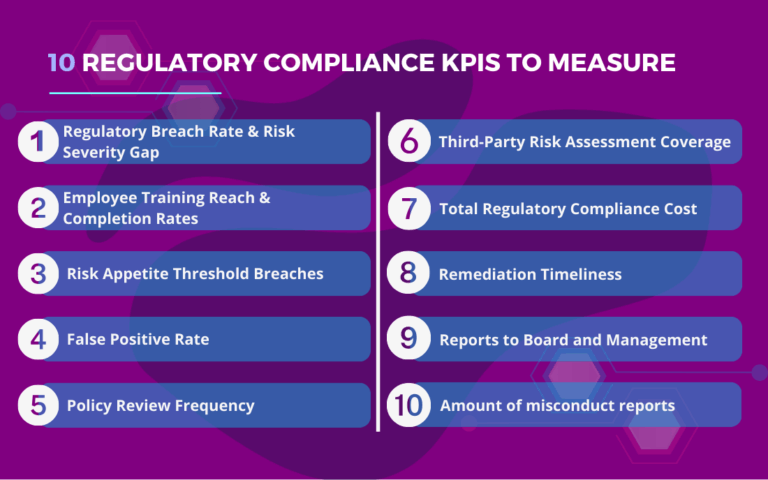
Below we summarise 10 regulatory compliance KPIs we believe insurance leaders must measure and report on:

10 compliance KPIs every insurance leader should measure visual
1. Regulatory Breach Rate & Risk Severity Gap

Regulatory Breach Rate measures the number of confirmed compliance breaches within a defined reporting period, providing a clear view of control breakdowns and systemic weaknesses. However, insurers should pair breach frequency with risk severity classification, assessing each incident based on financial impact, customer harm, operational disruption and regulatory consequence. A small number of high-severity breaches can pose far greater risk than a larger volume of low-impact issues.

2. Employee Training Reach and Completion Rates

Track mandatory regulatory training completion, including role-specific and conduct-focused modules. Beyond simple completion percentages, leaders should monitor overdue certifications and assess whether training correlates with improved control outcomes.

3. Risk Appetite Threshold Breaches

Measure instances where compliance or conduct metrics exceed defined risk appetite thresholds. This ensures alignment between board-approved tolerances and operational reality, and provides early warning where exposure is drifting beyond acceptable levels.

4. False Positive Rate

The False Positive Rate measures the percentage of compliance alerts or monitoring triggers that are reviewed and ultimately determined not to represent a genuine risk or breach. In insurance, this is particularly relevant in areas such as financial crime screening, transaction monitoring and automated compliance controls. A high false positive rate can create operational inefficiency, increase costs, and distract teams from real risks, while an unusually low rate may indicate that controls are too narrow.

5. Policy Review Frequency

Policy Review Frequency tracks how regularly compliance policies and procedures are formally reviewed and updated. In insurance, this ensures governance frameworks remain aligned with evolving regulatory requirements and business changes. Policy review also involves the monitoring and review of regulatory technology used and whether it’s time to update it or not. Therefore, policies must stay aligned with technology adopted to maintain oversight and meet regulatory expectations.

6. Third-Party Risk Assessment Coverage

Firms must measure the percentage of third parties that have undergone risk assessment, due diligence, and ongoing monitoring in line with policy requirements. Given the regulatory focus on outsourcing and operational resilience, gaps in third-party oversight can create significant supervisory and reputational exposure.

7. Total Regulatory Compliance Cost

Total Regulatory Compliance Cost measures the full expense of meeting regulatory obligations, including staffing, technology, training, audits, third-party services, and remediation efforts. Tracking this metric helps leaders understand the financial impact of compliance programs, identify cost drivers, and make data-driven decisions to optimise efficiency without compromising risk coverage. It also provides visibility into whether resources are proportionate to risk exposure and regulatory requirements.

8. Remediation Timeliness

Track the average time taken to close compliance issues, audit findings, or regulatory actions. Prolonged remediation cycles can indicate weak accountability, poor resource allocation, or ineffective governance. Regulators increasingly scrutinise not just identification of issues, but the speed and quality of resolution.

9.  Reports to Board and Management

Tracking the frequency, quality and timeliness of compliance and risk reports provided to the board and senior management is essential. Regular, structured reporting ensures leadership has clear visibility of key risks, breaches, control effectiveness and regulatory developments. Strong reporting supports informed decision-making, accountability and demonstrates proactive governance to regulators.

10.  Amount of Misconduct Reports

This metric tracks the volume of reported employee or third-party misconduct incidents within a given period, including breaches of conduct policies, ethical violations or non-compliance. In insurance, monitoring misconduct reports helps leaders identify cultural risks, emerging behavioural patterns, and potential control weaknesses. Analysing trends, reporting channels, and resolution outcomes also provides insight into the effectiveness of internal governance.

The role of RegTech and technology in supporting regulatory compliance and reporting
How Technology Supports in Measuring Regulatory Compliance and Reporting?

Technology, particularly RegTech software, play a critical role in transforming regulatory compliance from a manual, retrospective process into a data-driven, real-time discipline.

In the insurance sector, where regulatory obligations span multiple jurisdictions and third-party ecosystems, automated systems centralise risk data, standardise control assessments, and continuously monitor key compliance indicators.

RegTech enables firms in insurance to automate regulatory mapping, control testing, alert generation and reporting workflows, which significantly reduces human error and increases consistency.

They also improve data aggregation across business units and third parties, providing a “single source of truth” for compliance metrics. Advanced analytics and configurable dashboards allow leadership to track leading and lagging indicators, monitor risk appetite thresholds and generate board-ready reports with greater accuracy and speed.

Moreover, the power of RegTech lies in its capability to customise dashboards and metrics in line with wider business goals and objectives. While there are a set of standard metrics that could be tracked, firms have the choice and freedom to add different KPIs they think matter the most.

Ultimately, technology strengthens regulatory defensibility by creating audit trails, improving transparency, and enabling proactive risk identification, shifting compliance reporting from reactive justification to demonstrable, continuous oversight.

Ending Note

The importance of defining and tracking clear regulatory compliance KPIs can’t be stressed enough. From ensuring firms are actively complying with regulators’ laws to measuring compliance programs’ success, utilising technology allows companies to take control of their tracking and reporting capabilities and enables them to centralise this process in one single platform, which in turn reduces siloes and increases transparency across the entire organisation, not just compliance teams.

Speak to one of our experts to learn how REG Technologies can help you.

This article was published by:

Article author:

Picture of Manal Tjiou, Marketing Executive at REG Technologies
Manal Tjiou

Manal Tjiou is the Marketing Executive at REG Technologies. With a passion for digital marketing and creative strategy, she’s commited to increasing our brand awareness and thought leadership in the industry, ensuring our content resonates well with our audience.

020 3946 2880

info@reg.uk.com

See how The REG Network can help you

Talk to one of our experts to start streamlining your processes