












Blogs

Your Complete AML Compliance Checklist (Risks and Best Practices)

24th February 2026

Your Complete AML Compliance Checklist (Risks and Best Practices)

Anti Money Laundering (AML) checks are a fundamental regulatory requirement of every single insurance firm, and making use of the right systems and technology ensures that businesses are always compliant with regulators’ laws. Failing to carry out appropriate checks can significantly jeopardise a business’s operations, leading to expensive fines, reputational damage and loss of trust from both customers and the market…

AML Compliance Figures

According to Smart Search, approximately 10% of all AML breaches that have happened worldwide were due to AML compliance failures.

The UK is ranked second after the United States for worst-offending countries when it comes to AML events in the last 10 years, with a total of 1664 AML events. Moreover, among the UK’s most common money laundering events is AML compliance failures with 23%.

Fraud also topped the list as reported by UK Finance, with 2.09 million cases of fraud in the first six months of 2025, which represents a 17% jump from the same period in 2024, with a whopping amount of £629.3 million lost.

These figures are just the tip of the iceberg of the severity of AML breaches, whether done consciously or accidentally. Most of the time, firms fall into the AML trap because they don’t have proper robust systems in place that can give them real-time data of any suspicious activity that their trading partners might be engaging with.

This is where having access to a comprehensive AML checklist, supported by investing in a robust RegTech tool, comes in handy, turning AML disasters into strong competitive advantage.

What does AML Compliance implicate for Financial Services Institutions

Anti-Money Laundering compliance represents a set of standards and criteria that supports insurers and financial institutions trace transactions and stop fraudsters and criminals early on.

The financial services and insurance market are compelled by the FCA to respect AML compliance rules, making sure they have appropriate strategies in place to mitigate risk.

The FCA puts AML compliance right at the top, and failure to abide by the rules can even lead to imprisonment in some cases, in addition to hefty fines. As SmartSearch further reports: “One third of these firms freely admit they would need more than a week to compile a compliance audit, if they found themselves under investigation.”

Among the legislations and watchdogs that set out the laws to prevent money laundering not only in the UK, but also in America, Europe and Asia are:

  1. The Financial Action Task Force – FATF (US)
  2. Financial Conduct Authority – FCA (UK)
  3. The Money Laundering, Terrorist Financing and Transfer of Funds Regulations 2017 – (MLR 2017) (EU)
  4. Office of Financial Sanctions – OFSI (UK)
  5. The Terrorism Act (UK)
  6. Authority for Anti-Money Laundering and Countering the Financing of Terrorism – AMLA (EU)
  7. Transfers of Funds – TFR (EU)
  8. Proceeds of Crime Acts – POCA (UK)
  9. Financial Services and Market Act 2000 – FSMA (UK)
  10. Anti-Money Laundering and Counter-Terrorism Financing Act – AML/CTF (Australia)
The Importance of AML Checks And Compliance in Insurance

The importance of conducting thorough AML compliance checks can’t be stressed enough. As financial products and services offered by insurers can be exploited for illicit purposes, robust AML procedures help safeguard both companies and customers from fraud, money laundering and financial crime. Here’s why AML checks are so important in insurance:

Regulatory Requirement: Insurance companies must comply with national and international regulations that mandate thorough AML checks to prevent illegal activities.

Risk Mitigation: Effective AML compliance helps insurers identify suspicious transactions early, reducing the risk of being involved, knowingly or unknowingly, in money laundering schemes.

Protecting Reputation: Adhering to strict AML protocols protects an insurer’s reputation by demonstrating a commitment to ethical business practices.

Customer Trust: When customers know their insurer follows rigorous compliance standards, it builds trust and confidence in the company’s operations.

Avoiding Financial Penalties: Non-compliance with AML regulations can result in severe fines and legal consequences for insurance providers.

Enhanced Due Diligence: Regularly conducting AML checks enables insurers to better understand both their partners’ and clients’ backgrounds, ensuring that only legitimate businesses and policyholders are onboarded.

Levels of AML compliance - Insurers, MGAs and Brokers

All insurance players, whether they’re managing General Agents (MGAs), brokers or insurers, plays a distinct role in ensuring robust AML practices in the market. Understanding these differences is essential when evaluating trading partners.

MGAs (Managing General Agents):

MGAs have a crucial role in the insurance value distribution chain, and act as intermediaries with delegated authority from insurers to underwrite policies and manage claims.

Their AML responsibilities are often twofold: conducting due diligence on both clients and upstream partners like brokers or insurers. MGAs must implement Know Your Customer (KYC) and know your business (KYB) procedures, monitor transactions for suspicious activity and ensure that any third-party agents they work with adhere to the same AML standards. Regular training and internal audits are also crucial to maintain compliance.

Brokers:

Brokers bridge the gap between customers and insurers or MGAs. Their primary AML duty is customer identification; verifying client identities before facilitating coverage or financial transactions.

Brokers should screen clients against sanctions lists, perform ongoing monitoring for unusual behaviour and report any suspicious activities to the relevant authorities.

As trading partners, brokers need to demonstrate transparent onboarding processes and provide evidence of continuous counterparty risk management too.

Insurance Carriers:

Insurers hold ultimate responsibility for policy issuance and claims payments; therefore, their AML obligations are comprehensive. They must oversee all distribution channels, including MGAs and brokers, to ensure consistent compliance across the board.

Insurers conduct enhanced due diligence on high-risk accounts, monitor large or complex transactions closely, and maintain detailed records for regulatory reviews. From a trading partner’s perspective, an insurer’s ability to enforce uniform standards throughout their network is a key indicator of effective AML control.

By understanding how each entity approaches AML compliance, from initial checks through ongoing monitoring, insurers, brokers and MGAs can better evaluate risk exposure within their business relationships in the insurance sector.

What’s an AML Compliance Checklist?

An AML compliance checklist is a list of questions, facts or specific compliance areas designed to help organisations ensure they’re meeting regulatory requirements related to the prevention of money laundering and terrorist financing. This checklist can typically be seen as a guide that firms can follow to ensure they’re not leaving any gaps in their checks.

By following an AML compliance checklist, insurers can systematically review their processes, identify gaps or weaknesses in their anti-money laundering program and take corrective actions when necessary. This proactive approach not only helps avoid hefty fines and legal consequences but also strengthens the business’s reputation.

8 Core Components of an Effective AML Compliance Checklist
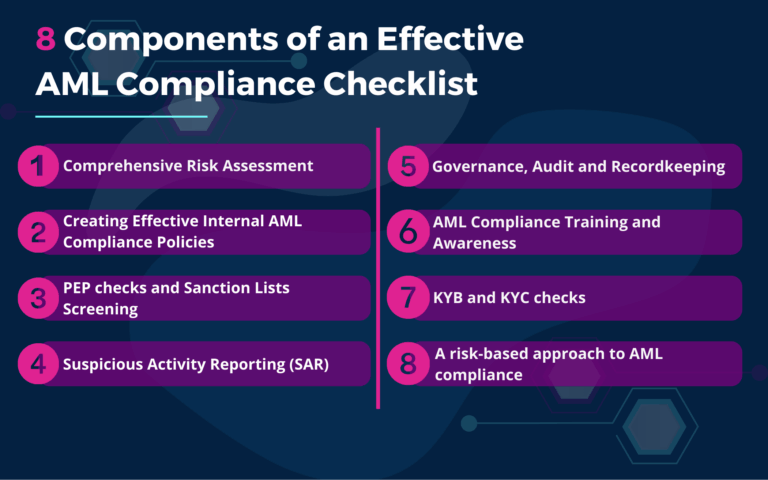
8 core components of an effective AML compliance checklist visual

a. Simplified Due Diligence (SDD)

SDD is applied in situations where the risk of money laundering or terrorist financing is considered low. This step involves basic verification of an individual’s identity and may include collecting minimal information such as names, addresses, and dates of birth. SDD allows businesses to streamline their processes while still adhering to regulatory requirements.

b. Standard Customer Due Diligence (CDD)

Standard CDD is the most commonly used approach and applies to most customers and business partners. It requires firms to gather comprehensive information about their clients, including identification documents, business registration details for corporate clients and trading partners, and an understanding of the nature of their business activities. This step aims to assess the risk level associated with each firm effectively.

c. Enhanced Due Diligence (EDD)

EDD comes into play when dealing with higher-risk customers or businesses that require deeper scrutiny due to factors such as geographical location or industry type. This step involves more extensive background checks, PEP and sanctions screening, adverse media screening , and a thorough assessment of potential risks associated with an individual or business profile. EDD ensures that businesses maintain robust safeguards against financial crime.

1. Comprehensive Risk Assessment

An effective AML compliance framework in the insurance industry begins with evaluating the money laundering and financial crime risks associated with potential business partners before entering into or maintaining a relationship.

This involves assessing the partner’s business model, ownership and control structure, geographic footprint, customer base, regulatory status and reputation. Particular attention is given to partners operating in high-risk jurisdictions, offering higher-risk products or services, or relying heavily on third parties and intermediaries.

The assessment also reviews the partner’s AML governance framework, internal controls and compliance culture to determine whether they meet acceptable standards. Findings from the risk assessment are documented, risk-rated and used to inform onboarding decisions, contractual safeguards and the level of ongoing monitoring required throughout the partnership.

2. Creating Effective Internal AML Compliance Policies

A robust AML compliance program is supported by clearly documented policies and procedures that reflect applicable laws, regulations and industry standards in the UK and around the world. These policies define roles and responsibilities, outline customer onboarding and monitoring requirements, and establish controls for detecting and reporting suspicious activity.

Insurance-specific risks, such as early policy surrender, policy loans and third-party premium payments, should be explicitly addressed. Policies must be reviewed and updated regularly to reflect regulatory changes and operational developments.

Internal AML procedures should outline clear standards for reviewing new products, monitoring transactions, and reporting suspicious activity through well-defined internal processes. They must also include a robust client onboarding and verification framework, supported by qualified personnel responsible for overseeing regulatory controls and preparing compliance reports.

3. PEP checks and Sanction Lists Screening

Sanctions and watchlist screening ensures insurers do not engage in prohibited or high-risk relationships or transactions. Customers, beneficiaries, agents, intermediaries and business partners should be screened against applicable sanctions lists, politically exposed persons (PEPs) databases, and adverse media sources at onboarding and on an ongoing basis.

PEP checks should identify both domestic and foreign PEPs, as well as their family members and close associates, with appropriate risk classification and escalation for enhanced due diligence where required. Event-driven screening, such as during claims payouts, policy assignments, beneficiary changes, or partner onboarding, is critical to managing sanctions and PEP-related risks.

Screening results must be reviewed promptly, investigated where matches are identified, escalated in line with internal procedures and fully documented to demonstrate regulatory compliance.

4. Suspicious Activity Reporting (SAR)

Suspicious Activity Reporting is a key regulatory obligation that supports efforts to combat money laundering and terrorist financing, including risks arising from B2B relationships.

Insurers must maintain clear internal escalation procedures to ensure suspicious activity involving customers, intermediaries or business partners is promptly identified, assessed and documented.

The SAR submission process must be quick and confidential to avoid alerting the suspected entity and should record the organisation’s authorised identity, details of the transaction, the justification for suspicion and any activities relevant to regulatory obligations.

This may include unusual premium flows, claims activity, or partner transactions inconsistent with the nature of the relationship. SARs or STRs must be submitted to the relevant Financial Intelligence Unit within prescribed timelines, and employees must be trained to recognise red flags while maintaining confidentiality.

5. Governance, Audit and Recordkeeping

Strong governance underpins the effectiveness of an AML compliance program. Senior management and the board are responsible for overseeing AML controls and ensuring adequate resources are allocated. Independent audits and compliance reviews should be conducted to assess the effectiveness of policies, procedures and controls.

Insurers must also maintain accurate records of customer due diligence (CDD) records collected during onboarding, transaction details showing the institution’s role, information on clients’ sources of wealth, and records of sanctioned individuals to support regulatory examinations and investigations.

records collected during onboarding, transaction details showing the institution’s role, information on clients’ sources of wealth, and records of sanctioned individuals

6. AML Compliance Training and Awareness

Ongoing AML training and awareness programs are essential to ensure compliance teams and employees understand their obligations and can effectively identify potential risks.

Training should be role-based, addressing the specific responsibilities of underwriting, sales, claims, and compliance departments. Employees must be familiar with internal policies, red flags relevant to insurance products and reporting procedures.

Regular refresher training, both within the business and outside, helps maintain awareness and supports a strong compliance culture across the organisation.

7. KYB and KYC checks

KYC is a fundamental component of any robust Anti-Money Laundering (AML) compliance checklist. KYC refers to the process by which businesses verify the identity of their clients, ensuring that they’re not engaging with individuals or entities involved in illicit activities such as money laundering or terrorist financing.

As part of AML compliance, KYC procedures typically require collecting and verifying customer information, including names, addresses, dates of birth and official identification documents.

Incorporating KYC into an AML compliance checklist helps organisations assess risk profiles and monitor ongoing transactions for suspicious activity. Effective KYC processes also support due diligence efforts by establishing a clear understanding of each customer’s financial behaviour and source of funds.

By making KYC an integral part of AML protocols, companies can better protect themselves from regulatory penalties while fostering trust with clients and stakeholders.

8. A risk-based approach to AML compliance

In the context, financial services and insurance firms need to ensure they have the right systems in place to mitigate AML risks. So they need to ask themselves questions such as:

  1. Do we leverage technology and compliance software to prevent AML breaches?
  2. Are the systems we use robust enough to warn us of AML red flags ahead of time?
  3. Is our sanctions and PEPs monitoring process automated and centralised?
  4. Does your compliance provider have access to secure and comprehensive databases and sources for reliable in-depth verifications?

These questions just scratch the surface of what needs to checked to ensure businesses minimise risk as much as possible.

We’ve also compiled a list of questions and things firms need to tick off their AML compliance checklists, which you can access below:

The Role of RegTech in Simplifying AML Compliance Checks

RegTech has proved time and time again its indispensable role in facilitating AML compliance checks, whether it’s through automating sanctions, PEPs and adverse media screening, automating new client monitoring and onboarding, or providing compliance teams with real-time reporting dashboards and keeping them always alert on all regulatory updates and new laws that could impact their operations.

According to our research, 87% of our respondents use RegTech to stay informed about changes in regulations and laws. This not only minimises the risk of non-compliance but also allows companies to focus on delivering better customer experiences.

For example, Generis Underwriting, one of our customers struggled with data siloes as they used mainly manual operations to obtain information around AML compliance violations. However, REG Technologies automated their partner oversight processes and enabled them to mitigate risk properly and in a timely manner.

RegTech also eliminates human error and guesswork, giving firms peace of mind when it comes to adhering to watchdogs’ AML laws. Manual AML processes are extremely time consuming, which undoubtedly increases the administrative burden on compliance teams. In fact, Gartner estimates that poor data quality results in average annual losses of $12.9 million for businesses.

RegTech finally helps automate customer due diligence, monitor transactions in real-time, flag suspicious activities with greater accuracy and generate comprehensive audit trails for regulators, all with minimal human intervention.

This in turn empowers insurance organisations to simplify AML compliance checks while enhancing both efficiency and regulatory confidence and keeping long-term compliance costs down.

The Future of AML compliance

As regulators reinforce their laws, insurance firms have to adapt and prepare for the future of AML compliance checks; one that’s powered by robust systems that transform risk into advantage.

On one hand, technology will keep revolutionising how firms manage their counterparties and potential future partners and ensure they’re not engaging in prohibited activity.

On the other hand, stronger systems mean that fraudsters and criminals are becoming more and more intelligent, with capabilities that will force firms to invest in regulatory technology or be penalised.  

Even though a lot of businesses still rely on manual processes to conduct AML checks, only the ones who adapt and use advanced technology, powered by machine learning and AI, can keep growing without falling into the penalties and reputational damage trap.

Speak to one of our experts to learn how REG Technologies can help you.

This article was published by:

Article author:

020 3946 2880

info@reg.uk.com

See how The REG Network can help you

Talk to one of our experts to start streamlining your processes